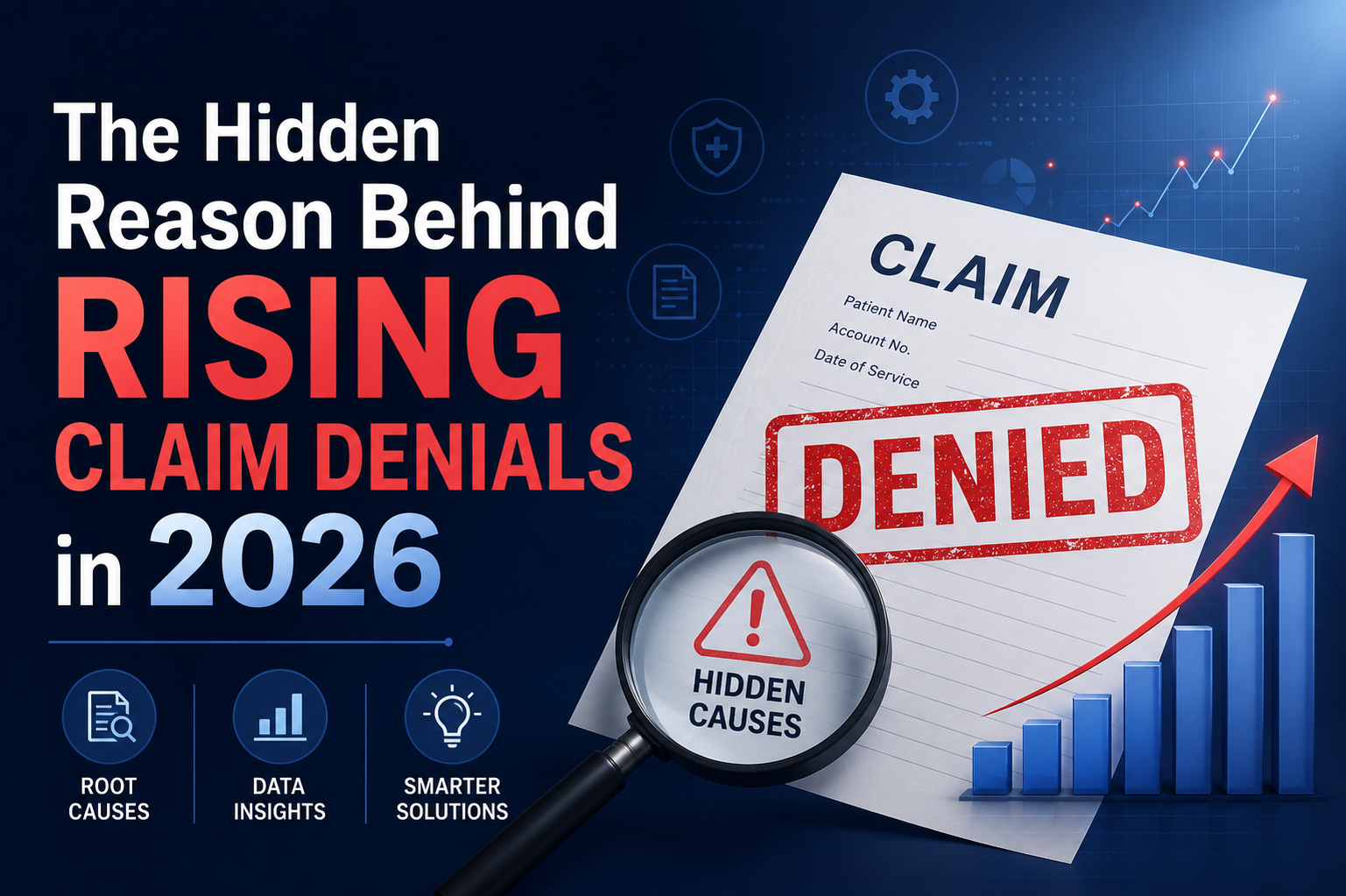
Healthcare organizations across the United States are facing a growing challenge in 2026 – rising claim denials. While many providers assume denials happen because of coding errors or missing documents, the real issue is becoming much deeper and more complex. Hospitals, physician groups, and revenue cycle teams are now dealing with evolving payer rules, AI-driven audits, stricter documentation requirements, and delayed authorization workflows that are increasing denial rates faster than ever before.
For healthcare providers, claim denials are no longer just a billing issue. They directly impact cash flow, operational efficiency, patient satisfaction, and long-term revenue integrity. Understanding the hidden reasons behind these rising denials is critical for healthcare organizations that want to stay financially stable in today’s changing reimbursement landscape.
Why Claim Denials Are Increasing in 2026?
The healthcare industry has rapidly adopted automation and AI-based validation systems. Insurance payers are using advanced technologies to review claims more aggressively before reimbursement approval. Even small inconsistencies in documentation, coding, eligibility verification, or medical necessity can trigger denials instantly.
Several healthcare organizations are still relying on outdated workflows that cannot keep pace with these changes. As payer systems become smarter, providers must also modernize their revenue cycle processes.
The increase in denials is mainly driven by:
- AI-powered payer audits
- Incomplete clinical documentation
- Incorrect medical necessity validation
- Delayed prior authorizations
- Coding inconsistencies
- Eligibility verification failures
- Lack of real-time claim monitoring
- Frequent payer policy updates
- Communication gaps between clinical and billing teams
The Hidden Reason Most Providers Overlook
The hidden reason behind rising claim denials in 2026 is disconnected healthcare workflows.
Many hospitals and healthcare organizations still operate with siloed systems where clinical documentation, coding, billing, utilization review, and denial management teams work independently. This disconnect creates gaps in data accuracy and claim validation.
For example:
- A physician may document a condition differently than the coder interprets it.
- The billing team may submit claims before authorization updates are completed.
- Clinical teams may fail to capture severity indicators needed for reimbursement.
- Payer-specific documentation requirements may not be updated in real time.
These workflow gaps lead to preventable denials that could have been avoided through integrated revenue cycle intelligence.
The Role of AI in Modern Claim Denials
In 2026, insurance payers are heavily using Artificial Intelligence and predictive analytics to identify claims that appear risky or incomplete. AI systems can instantly compare submitted claims against payer policies, historical billing patterns, medical necessity guidelines, and patient eligibility records.
This means claims are being denied faster than ever before.
Traditional manual review processes cannot compete with automated payer intelligence systems. Healthcare organizations that still rely only on manual auditing often discover issues only after claims are rejected.
Modern revenue cycle management now requires proactive denial prevention rather than reactive denial correction.
Documentation Gaps Are Becoming Costlier
Clinical documentation has become one of the biggest factors affecting reimbursement accuracy. Even when services are medically appropriate, insufficient documentation can lead to claim denials.
Common documentation-related issues include:
- Missing physician signatures
- Incomplete progress notes
- Lack of medical necessity support
- Incorrect diagnosis specificity
- Missing procedure details
- Inconsistent patient history records
As payer scrutiny increases, providers must ensure documentation accuracy from the beginning of the patient encounter.
Strong Clinical Documentation Integrity (CDI) programs are becoming essential for hospitals and physician groups aiming to reduce denial rates.
Prior Authorization Challenges Continue to Grow
Prior authorization remains a major contributor to claim denials in 2026. Many healthcare providers struggle with delayed approvals, incomplete submissions, and changing payer requirements.
Without real-time authorization tracking, claims may be submitted with outdated or missing approval information.
Healthcare organizations are increasingly investing in automated authorization workflows that help:
- Verify payer requirements instantly
- Track approval timelines
- Reduce manual follow-ups
- Prevent authorization-related denials
- Improve patient scheduling efficiency
Automation is no longer optional in modern healthcare revenue management.
How Coding Accuracy Impacts Claim Approval?
Accurate medical coding continues to play a major role in claim acceptance rates. However, coding alone is not enough anymore.
In 2026, payers evaluate coding together with:
- Clinical documentation
- Medical necessity
- Treatment timelines
- Patient risk profiles
- Authorization status
- Value-based care measures
Even correctly coded claims may still be denied if supporting documentation does not align with payer expectations.
This is why healthcare organizations are adopting AI-enabled coding audits and real-time validation tools to identify potential issues before claim submission.
The Financial Impact of Rising Claim Denials
Claim denials significantly affect healthcare financial performance. Denied claims increase administrative costs, delay reimbursements, and create additional workload for revenue cycle teams.
The financial consequences include:
- Reduced cash flow
- Increased accounts receivable days
- Higher operational expenses
- Lost reimbursement opportunities
- Staff burnout
- Delayed patient billing resolution
Many denied claims are never fully recovered, leading to permanent revenue leakage for healthcare providers.
Organizations that fail to improve denial prevention strategies may struggle with long-term financial sustainability.
Strategies to Reduce Claim Denials in 2026
Healthcare organizations must shift from reactive denial management to proactive denial prevention. The focus should be on improving workflow integration, automation, and real-time revenue intelligence.
1. Strengthen Clinical Documentation
Providers should ensure complete, accurate, and timely documentation throughout the patient care process. Strong CDI programs help reduce documentation-related denials.
2. Implement AI-Driven Revenue Cycle Tools
AI-powered solutions can identify missing information, coding inconsistencies, authorization gaps, and payer-specific risks before claims are submitted.
3. Improve Communication Between Teams
Clinical, coding, billing, and utilization review teams must work collaboratively rather than independently. Integrated workflows improve claim accuracy significantly.
4. Monitor Payer Policy Changes Regularly
Insurance payer rules change frequently. Healthcare organizations should continuously track updates to avoid compliance and reimbursement issues.
5. Use Real-Time Eligibility Verification
Automated eligibility verification helps prevent denials caused by inactive coverage, policy restrictions, or demographic errors.
6. Conduct Pre-Bill Audits
Pre-bill claim reviews can identify high-risk claims early and reduce downstream denial rates.
The Future of Denial Prevention
The healthcare industry is entering an era where intelligent automation will define revenue cycle success. Organizations that continue using fragmented manual workflows may face rising denial rates and declining financial performance.
Future-ready healthcare providers are focusing on:
- AI-enabled denial prevention
- Predictive revenue analytics
- Automated workflow management
- Real-time coding validation
- Integrated clinical and financial systems
- Smart payer communication platforms
The goal is no longer just faster claim submission — it is accurate, compliant, and denial-resistant reimbursement workflows.
Final Thoughts
The hidden reason behind rising claim denials in 2026 is not simply coding errors or missing documents. The real issue lies in disconnected healthcare workflows, evolving payer intelligence systems, and the growing complexity of modern reimbursement requirements.
Healthcare organizations must adopt smarter, integrated, and AI-enabled revenue cycle strategies to stay ahead of denial trends. By improving documentation accuracy, workflow collaboration, real-time validation, and automation, providers can significantly reduce denials and protect financial performance.
As the healthcare reimbursement landscape continues to evolve, proactive denial prevention will become one of the most important pillars of successful revenue cycle management in 2026 and beyond.