Introduction
Healthcare organizations are facing increasing financial pressure in 2026. Rising operational costs, evolving payer requirements, stricter regulatory scrutiny, and growing denial rates are forcing hospitals and health systems to rethink their revenue cycle strategies. In this environment, revenue integrity has become more than a financial objective it is a strategic necessity.
Revenue integrity ensures that healthcare organizations receive accurate reimbursement for the services they provide while maintaining compliance with regulatory requirements. Achieving this goal requires a collaborative approach involving Medical Coding, Clinical Documentation Improvement (CDI), and Coding Audits.
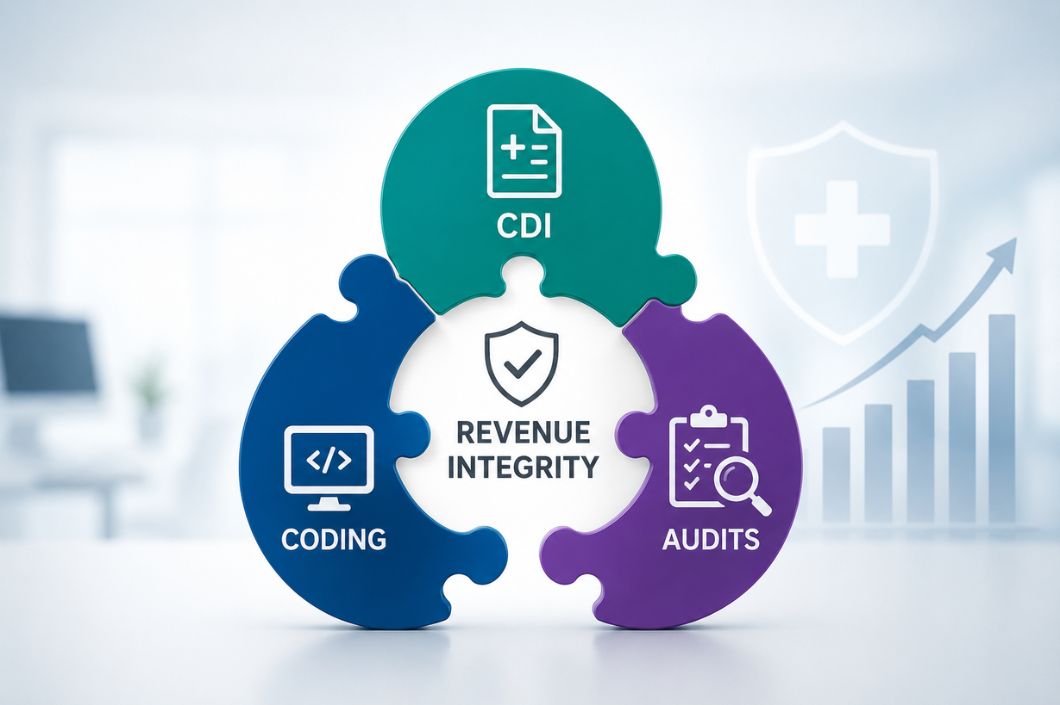
Traditionally, these functions have operated independently. However, modern healthcare organizations are discovering that when coding, CDI, and audits work together, they create a powerful framework for improving reimbursement accuracy, reducing denials, enhancing compliance, and protecting long-term financial health.
This article explores why the integration of coding, CDI, and audits is critical for revenue integrity in 2026 and how healthcare organizations can benefit from a coordinated strategy.
Understanding Revenue Integrity
Revenue integrity is the process of ensuring that all clinical services provided to patients are accurately documented, coded, billed, and reimbursed.
A successful revenue integrity program focuses on:
- Accurate clinical documentation
- Precise medical coding
- Regulatory compliance
- Denial prevention
- Revenue optimization
- Risk mitigation
Without a strong revenue integrity framework, healthcare organizations risk underpayments, claim denials, compliance penalties, and revenue leakage.
As healthcare reimbursement models continue to evolve toward value-based care, the importance of revenue integrity has never been greater.
The Critical Role of Medical Coding
Medical coding serves as the foundation of the revenue cycle. Coders translate clinical documentation into standardized diagnosis and procedure codes that determine reimbursement.
Accurate coding directly impacts:
- DRG assignment
- Risk adjustment scores
- Reimbursement levels
- Quality reporting
- Compliance outcomes
Even minor coding errors can result in significant financial consequences. Common challenges include:
- Missing diagnoses
- Incomplete procedure coding
- Incorrect code selection
- Documentation inconsistencies
- Regulatory updates
In 2026, healthcare organizations are increasingly adopting AI-assisted coding solutions to improve efficiency. However, technology alone cannot guarantee accuracy. Human expertise remains essential to validate complex clinical scenarios and ensure compliance.
Why CDI Matters?
Clinical Documentation Improvement (CDI) bridges the gap between clinical care and coding accuracy.
CDI specialists work with providers to ensure medical records accurately reflect:
- Patient severity of illness
- Risk of mortality
- Comorbid conditions
- Clinical complexity
- Treatment decisions
Strong documentation supports accurate code assignment and appropriate reimbursement.
Without effective CDI programs, healthcare organizations often experience:
Increased Claim Denials
Incomplete documentation frequently leads to payer disputes and denied claims.
Lost Revenue Opportunities
Missing diagnoses or undocumented conditions may result in lower reimbursement.
Compliance Risks
Poor documentation can create audit vulnerabilities and regulatory concerns.
Reduced Quality Scores
Documentation gaps can negatively impact quality reporting and performance metrics.
As value-based reimbursement continues to expand in 2026, CDI has become a critical component of organizational success.
The Growing Importance of Coding Audits
Coding audits provide an independent review of coding accuracy, documentation quality, and compliance performance.
Audits help organizations identify:
- Coding errors
- Documentation deficiencies
- Revenue leakage
- Compliance risks
- Training opportunities
There are several types of coding audits:
Prospective Audits
Reviews conducted before claims are submitted.
Benefits include:
- Early error detection
- Improved coding accuracy
- Reduced denials
- Faster reimbursement
Concurrent Audits
Reviews performed during patient encounters or active admissions.
Benefits include:
- Real-time documentation improvement
- Enhanced provider engagement
- Better reimbursement outcomes
Retrospective Audits
Reviews conducted after claims have been processed.
Benefits include:
- Trend analysis
- Revenue recovery
- Compliance monitoring
- Process improvement
Organizations that regularly conduct coding audits are better positioned to maintain revenue integrity and regulatory compliance.
Why Coding, CDI, and Audits Must Work Together?
The most successful healthcare organizations no longer view coding, CDI, and audits as separate departments.
Instead, they recognize that these functions form a connected ecosystem.
Documentation Drives Coding
Coders can only assign codes based on documented clinical evidence.
If documentation is incomplete, coding accuracy suffers.
Coding Validates Documentation
Coding teams identify documentation gaps and provide feedback that strengthens CDI initiatives.
Audits Measure Performance
Audits evaluate both coding accuracy and documentation quality, creating opportunities for continuous improvement.
When all three functions collaborate, organizations achieve:
- Improved coding accuracy
- Enhanced documentation quality
- Reduced denials
- Increased reimbursement
- Stronger compliance
- Better operational efficiency
This integrated approach is becoming a best practice across leading healthcare systems.
The Financial Impact of Collaboration
Revenue integrity initiatives can generate measurable financial benefits.
Organizations that align coding, CDI, and audit programs often experience:
Reduced Revenue Leakage
Accurate documentation and coding ensure all services are appropriately captured and reimbursed.
Lower Denial Rates
Proactive reviews identify issues before claims reach payers.
Faster Cash Flow
Cleaner claims result in quicker reimbursement and fewer payment delays.
Improved Audit Readiness
Strong documentation and coding practices reduce external audit risks.
Enhanced Compliance
Organizations can confidently navigate regulatory requirements while minimizing exposure to penalties.
In today’s healthcare environment, these advantages can significantly impact financial performance.
How AI is Transforming Revenue Integrity in 2026?
Artificial Intelligence is rapidly changing the way healthcare organizations approach revenue integrity.
Modern AI-powered solutions assist with:
- Clinical documentation analysis
- Coding recommendations
- Risk adjustment identification
- Audit prioritization
- Denial prediction
- Revenue opportunity detection
However, AI works best when combined with experienced coding and CDI professionals.
The most effective organizations use technology to enhance human expertise rather than replace it.
AI-driven insights enable teams to focus on high-risk cases, improve productivity, and strengthen revenue integrity outcomes.
Best Practices for Building a Strong Revenue Integrity Program
Healthcare organizations seeking to improve revenue integrity should consider the following strategies:
Foster Cross-Functional Collaboration
Encourage regular communication between coding, CDI, compliance, and audit teams.
Invest in Education
Continuous training helps staff stay current with coding guidelines and payer requirements.
Implement Prospective Reviews
Identifying issues before claim submission reduces costly rework.
Leverage Advanced Analytics
Data-driven insights help identify trends, risks, and improvement opportunities.
Utilize AI-Powered Solutions
Technology can improve efficiency while supporting accuracy and compliance.
Conduct Routine Audits
Regular audits create accountability and support continuous improvement.
How Alpine Pro Health Supports Revenue Integrity?
At Alpine Pro Health, we understand that achieving revenue integrity requires more than accurate coding alone.
Our comprehensive solutions combine:
- Certified medical coding expertise
- Clinical Documentation Improvement (CDI)
- Prospective and Retrospective Audits
- IPDRG Validation Reviews
- Risk Adjustment Coding
- Revenue Cycle Optimization
- Clinical-AI Enabled Audit Solutions
Through our advanced ARC+ platform, healthcare organizations can strengthen coding accuracy, improve documentation quality, reduce denials, and enhance revenue integrity across the entire revenue cycle.
By integrating coding, CDI, and audits into a unified strategy, we help healthcare organizations maximize reimbursement while maintaining compliance and operational excellence.
Conclusion
Revenue integrity has become a strategic priority for healthcare organizations in 2026. As reimbursement models grow more complex and compliance expectations continue to increase, isolated approaches are no longer sufficient.
Medical coding, Clinical Documentation Improvement (CDI), and coding audits must work together to create a comprehensive revenue integrity framework.
Organizations that successfully align these functions can improve reimbursement accuracy, reduce denials, strengthen compliance, and achieve long-term financial sustainability.
The future of healthcare revenue cycle management lies in collaboration, technology, and continuous improvement—and the organizations that embrace this approach will be best positioned for success.