
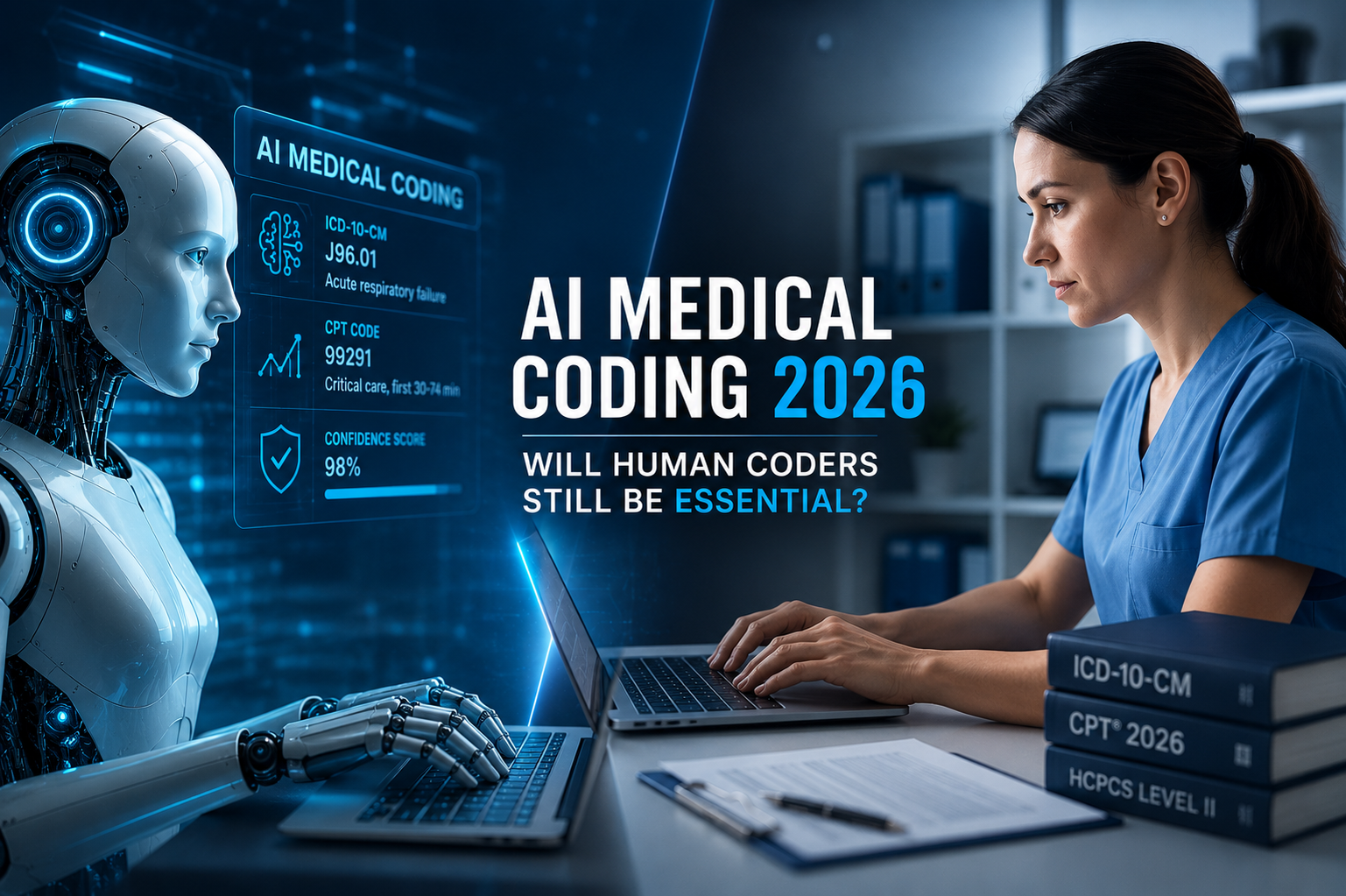
Artificial intelligence has quietly reshaped the back office of American healthcare. From prior authorization workflows to denial management dashboards, automation is no longer a future-state conversation, it is the present reality. Nowhere is that shift more visible, or more debated, than in AI medical coding. As medical coding technology grows sharper and faster, one question keeps surfacing in health system boardrooms and AAPC chapter meetings alike: Do we still need human coders working alongside AI?
The honest answer is more nuanced than either camp wants to admit and understanding it is critical for anyone navigating healthcare RCM trends in 2026.
How AI Medical Coding Technology Has Matured & Fast?
Just three years ago, most AI coding vendors were selling promise. Pilot programs showed accuracy rates that looked impressive in slide decks but faltered on complex, multi-condition inpatient encounters. Payers pushed back. Compliance officers raised eyebrows. Adoption was cautious.
By 2026, the landscape looks markedly different. Large language models trained on hundreds of millions of clinical documents, ICD-10 AI coding libraries, CPT automation engines, and payer-specific guidelines can now process an operative note, a discharge summary, or an emergency department record and return a suggested code set in seconds, often with AI coding accuracy that rivals an experienced coder on routine encounters.
Major vendors have reported autonomous medical coding rates (ACR) exceeding 80% on high-volume, low-complexity claim types such as outpatient radiology, lab, and primary care E&M visits. For health systems processing tens of thousands of claims per month, that throughput is transformational. It compresses coding backlogs, accelerates cash flow, and cuts per-claim costs substantially.
But “80% autonomous” also means 20% still requires a human. And that 20% is where the real revenue lives.
The Complexity Problem Autonomous Medical Coding Hasn’t Solved
Medical coding isn’t uniformly hard. Assigning a CPT code to a chest X-ray is categorically different from coding a multi-stage orthopedic revision surgery with a post-operative complication, three comorbidities, and a 14-day inpatient stay that crosses a DRG boundary. CPT automation excels at the former. It still struggles with the latter.
Here’s why:
Clinical ambiguity
AI models read what is documented. When a physician’s note is vague, incomplete, or contradictory, the model assigns the code it calculates as most probable which may not reflect what actually happened in that encounter. In the human coders AI partnership, it’s the human who queries physicians, understands clinical context, and recognizes when a documented “possible” diagnosis doesn’t support assignment under inpatient guidelines.
Payer nuance
Medicare, Medicaid, and commercial payers each maintain their own Local Coverage Determinations (LCDs), coverage policies, and modifier requirements. These rules change frequently and don’t always make it into a model’s training data in time. An experienced coder carries institutional knowledge that no AI has yet replicated at scale a gap that directly impacts revenue cycle management performance.
ICD-10 AI coding limitations
The annual ICD-10 and CPT updates, plus AHA Coding Clinic guidance, require ongoing human interpretation. When a new code category is introduced or when guidance shifts on sequencing an existing condition human coders apply reasoning. AI catches up, but often after errors have already entered the claim stream.
Audit and appeal support
When a claim is denied or flagged in a RAC audit, someone has to build the case. That requires a coder who can walk through documentation logic, locate clinical evidence, and write a compelling appeal narrative. That is not an AI function today.
What the Human Coders AI Partnership Is Actually Becoming?
The binary framing AI versus coders misses what is actually happening in high-performing revenue cycle management departments. The model that is winning is AI-assisted human coding, not AI replacement.
In practice, this means:
- AI handles volume; humans handle complexity. The autonomous medical coding engine processes the routine claim queue independently. Coders are routed only the encounters flagged for human review complex cases, high-dollar claims, cases with documentation gaps, or claim types with historically high denial rates.
- Coders shift into auditing and validation roles. Rather than assigning codes from scratch, many coders now review AI-generated code sets, validate AI coding accuracy, and catch errors before claims go out the door. This quality-assurance function is new, cognitively demanding, and requires a deep understanding of both coding guidelines and clinical documentation.
- Clinical documentation integrity collaboration intensifies. Clinical documentation integrity (CDI) specialists and coders are working more closely together than ever, because AI surfaces documentation gaps faster than any manual workflow could. Coders who understand CDI principles are increasingly valuable not less so.
- Coding leadership becomes strategic. Coding managers and directors are being asked to evaluate medical coding technology vendor performance, oversee accuracy benchmarking, and design escalation workflows expertise that only comes from years of hands-on coding experience.
The net effect is not fewer skilled coders. It is a different kind of skilled coder, one who is analytically stronger, more technology-fluent, and operating at a higher level of clinical and compliance sophistication.
What Healthcare RCM Trends Mean for Revenue Cycle Leaders?
For revenue cycle leaders tracking healthcare RCM trends, the implications are both financial and operational.
Denial rates tell the real story. Organizations that have deployed AI medical coding without adequate human oversight have seen denial rates creep upward on complex claim types, particularly in surgical, behavioral health, and high-acuity inpatient settings. The per-claim cost savings from CPT automation and ICD-10 AI coding are quickly offset when denials require rework, appeals, or write-offs. Human oversight is not overhead. It is risk management.
AI coding accuracy gaps have real dollar consequences. CPC, CCS, COC, and CIC credentials remain meaningful because the coders who remain in the workflow are handling the encounters with the greatest revenue impact. Their accuracy directly affects net revenue. If anything, the bar for human coders in an AI environment has risen not fallen.
Workforce planning requires a new playbook. Health systems cutting coding staff in anticipation of full autonomous medical coding are taking on substantial compliance and financial risk. A more measured approach redeploying coders into QA, clinical documentation integrity support, and audit functions as AI adoption scales protects both revenue and institutional knowledge.
The Bottom Line on AI Medical Coding in 2026
AI medical coding in 2026 is real, capable, and delivering measurable value across the revenue cycle management continuum. It is also incomplete and the gaps it leaves behind are not small ones. They are the gaps where underpayments, denied claims, and compliance exposure live.
Human coders are not obsolete. The human coders AI collaboration is, in fact, the most powerful configuration the industry has seen. The organizations that will win are not the ones that automate the fastest. They are the ones that apply medical coding technology thoughtfully, invest in coder reskilling, and recognize that AI coding accuracy at scale still depends on human expertise to catch what machines miss.
In healthcare RCM, accuracy is everything. And in 2026, accuracy still requires both.