
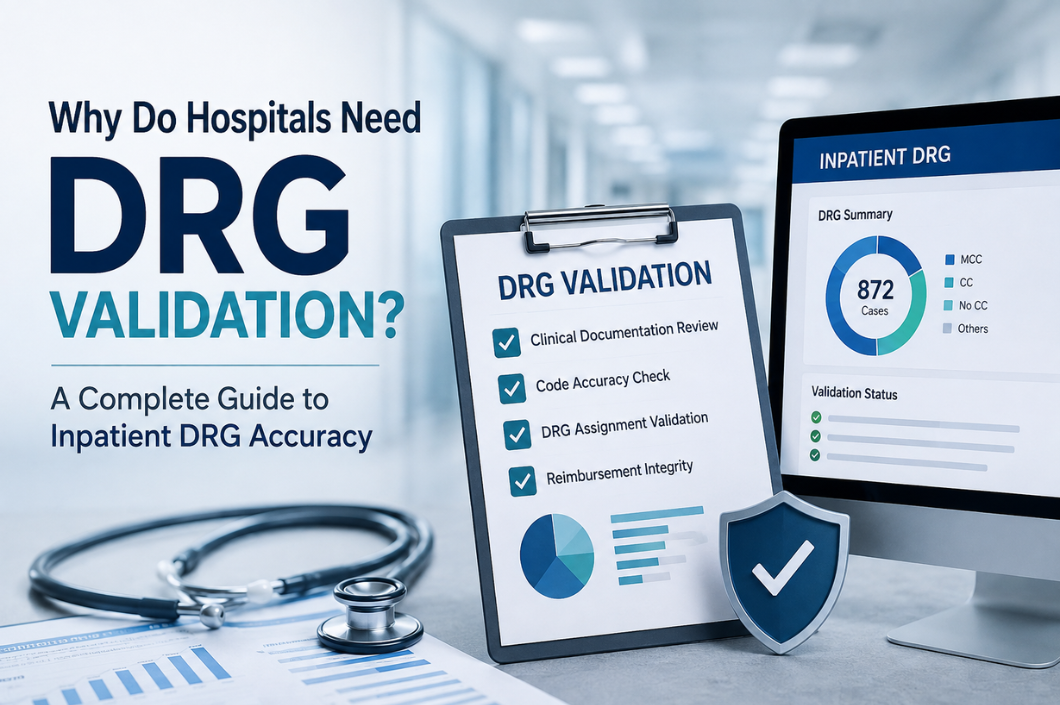
Hospitals manage thousands of inpatient cases every year, and accurate clinical documentation and coding are essential for appropriate reimbursement. One of the most important processes supporting this goal is DRG validation. By reviewing medical records, diagnoses, procedures, and clinical indicators, hospitals can identify whether the assigned Diagnosis-Related Group (DRG) accurately represents the patient’s condition and level of care.
With increasing reimbursement pressure, complex coding rules, and greater payer scrutiny, hospitals are investing in professional IPDRG services to strengthen coding accuracy, reduce financial risk, and improve revenue integrity.
What Is DRG Validation?
DRG validation is a detailed review process used to determine whether the DRG assigned to an inpatient hospital claim is supported by the patient’s clinical documentation.
Unlike a basic coding review, DRG validation focuses on whether the documented diagnoses and procedures are clinically supported by the medical record. The review may examine physician documentation, laboratory results, imaging, medications, treatment plans, nursing documentation, and other clinical indicators.
The objective is simple: the assigned inpatient DRG should accurately reflect the patient’s actual clinical condition and the services provided during the hospital stay.
An effective DRG validation process can help hospitals identify unsupported diagnoses, missing documentation, incorrect coding, and potential reimbursement discrepancies before or after claims are submitted.
Why Is Inpatient DRG Validation Important?
1. Improves Inpatient Coding Accuracy
Inpatient cases can involve multiple diagnoses, procedures, complications, and comorbidities. Even a small documentation or coding error can affect the final DRG assignment.
Inpatient DRG validation provides an additional level of review to determine whether the reported diagnoses and procedures are accurately supported by the medical record.
This helps hospitals improve the quality and consistency of their inpatient coding.
2. Protects Hospital Revenue
DRG assignment directly influences inpatient reimbursement. If a clinically supported condition is not appropriately captured, the hospital may receive less reimbursement than it is entitled to.
Conversely, unsupported diagnoses or procedures can create compliance and repayment risks.
Professional IPDRG services help hospitals identify discrepancies before they negatively affect revenue or create unnecessary financial exposure.
3. Reduces Claim Denials
Payers increasingly review inpatient claims for medical necessity, clinical validation, coding accuracy, and documentation consistency.
A DRG that does not appear to be supported by the clinical evidence can become a target for payer review or denial.
Regular DRG validation enables hospitals to identify potential weaknesses before claims reach the payer, supporting stronger documentation and more defensible claims.
4. Strengthens Clinical Documentation
Accurate DRG assignment depends heavily on complete and specific clinical documentation.
During validation, reviewers may identify situations where the medical record does not clearly support a reported diagnosis or where additional physician clarification may be appropriate.
These findings can support Clinical Documentation Improvement (CDI) initiatives and help physicians document clinically significant conditions more clearly.
5. Identifies Coding and Documentation Discrepancies
DRG validation can uncover differences between the clinical picture and the coded record.
For example, a patient’s laboratory findings, treatment, imaging results, and clinical course may not appear consistent with a particular diagnosis reported on the claim.
A structured validation review allows hospitals to investigate these discrepancies and determine whether the coding and documentation accurately represent the patient’s condition.
What Does a DRG Validation Audit Review?
A comprehensive DRG validation audit may examine several components of an inpatient medical record, including:
- Principal diagnosis
- Secondary diagnoses
- Complications and comorbidities
- Major Complications or Comorbidities (MCCs)
- Complications or Comorbidities (CCs)
- Procedures and surgical interventions
- Physician documentation
- Laboratory findings
- Diagnostic imaging
- Medication and treatment patterns
- Nursing documentation
- Present-on-admission indicators
- Discharge summaries
- DRG assignment
- Clinical indicators supporting reported diagnoses
The reviewer compares the documentation and clinical evidence with the assigned codes and DRG to determine whether the claim is appropriately represented.
How IPDRG Services Support Hospitals
Managing every aspect of inpatient DRG validation internally can require significant resources. Hospitals may therefore use specialized IPDRG services to supplement their internal coding, CDI, compliance, and revenue integrity teams.
An experienced IPDRG team can support hospitals with:
Pre-Bill DRG Validation:
Reviews cases before claims are submitted to identify potential coding, documentation, and DRG issues.
Post-Bill DRG Validation:
Reviews previously billed cases to identify missed revenue opportunities, inaccurate coding, and potential compliance concerns.
Inpatient Coding Audits:
Evaluates inpatient coding accuracy and identifies recurring areas requiring improvement.
DRG Reconciliation:
Compares the assigned DRG with clinical documentation and coding information to identify discrepancies.
Clinical Validation Reviews:
Determines whether documented diagnoses are supported by appropriate clinical evidence.
Physician Documentation Support:
Identifies documentation opportunities that can improve the accuracy and specificity of the medical record.
DRG Validation vs. Coding Validation
Although the terms are sometimes used interchangeably, DRG validation and coding validation have different areas of emphasis.
Coding validation primarily evaluates whether diagnoses and procedures have been appropriately coded according to applicable coding guidelines.
DRG validation goes further by examining whether the diagnoses and procedures assigned to the case are clinically supported and whether the resulting DRG accurately represents the patient’s hospitalization.
Both processes are valuable components of a comprehensive inpatient revenue integrity program.
Common Challenges Hospitals Face With DRG Validation
Hospitals may encounter several challenges when managing inpatient DRG accuracy, including:
- Complex clinical documentation
- Inconsistent physician documentation
- Rapidly changing coding requirements
- Increasing payer scrutiny
- Clinical validation denials
- Incorrect CC/MCC capture
- Principal diagnosis selection challenges
- Documentation and coding inconsistencies
- Limited availability of experienced inpatient auditors
- Large volumes of inpatient records
These challenges make systematic DRG validation increasingly important for hospitals seeking to maintain accurate reimbursement and compliance.
How Technology Can Improve DRG Validation
Technology is transforming the way healthcare organizations approach inpatient coding and DRG validation.
Advanced analytics and AI-enabled solutions can help identify unusual coding patterns, documentation inconsistencies, potential audit targets, and cases requiring additional review.
However, technology should complement—not replace—experienced coding and clinical expertise.
Combining AI-driven analytics with certified medical coders, clinical reviewers, and experienced auditors can create a more comprehensive approach to DRG validation.
Benefits of a Strong DRG Validation Program
A well-designed DRG validation program can provide hospitals with several long-term benefits:
- Improved inpatient coding accuracy
- Better documentation quality
- Reduced avoidable claim denials
- Stronger revenue integrity
- Identification of missed reimbursement opportunities
- Reduced compliance risk
- More consistent DRG assignment
- Improved audit preparedness
- Better collaboration between coding, CDI, and clinical teams
Rather than treating DRG validation as a one-time audit, hospitals can integrate it into their broader revenue integrity and compliance strategy.
Why Hospitals Should Prioritize DRG Validation
Inpatient reimbursement depends on the accuracy of the clinical story represented by the medical record, codes, and DRG. When these elements are not aligned, hospitals may face lost revenue, payer denials, compliance concerns, and unnecessary rework.
A structured DRG validation program provides hospitals with an opportunity to identify these issues and address them proactively.
By combining specialized IPDRG services, experienced inpatient coding professionals, clinical validation expertise, and technology-enabled auditing, hospitals can build a stronger approach to Inpatient DRG accuracy.
Conclusion
DRG validation is more than a financial review—it is an important component of healthcare revenue integrity, coding compliance, and documentation quality.
For hospitals dealing with complex inpatient cases and increasing payer scrutiny, professional IPDRG services can provide the expertise and additional oversight needed to validate DRG assignments effectively.
When clinical documentation, coding, and DRG assignment accurately reflect the patient’s care, hospitals are better positioned to support appropriate reimbursement, reduce avoidable denials, and maintain stronger compliance.
Accurate DRG validation ultimately helps hospitals tell the complete clinical story behind every inpatient claim while protecting both revenue and regulatory integrity.