
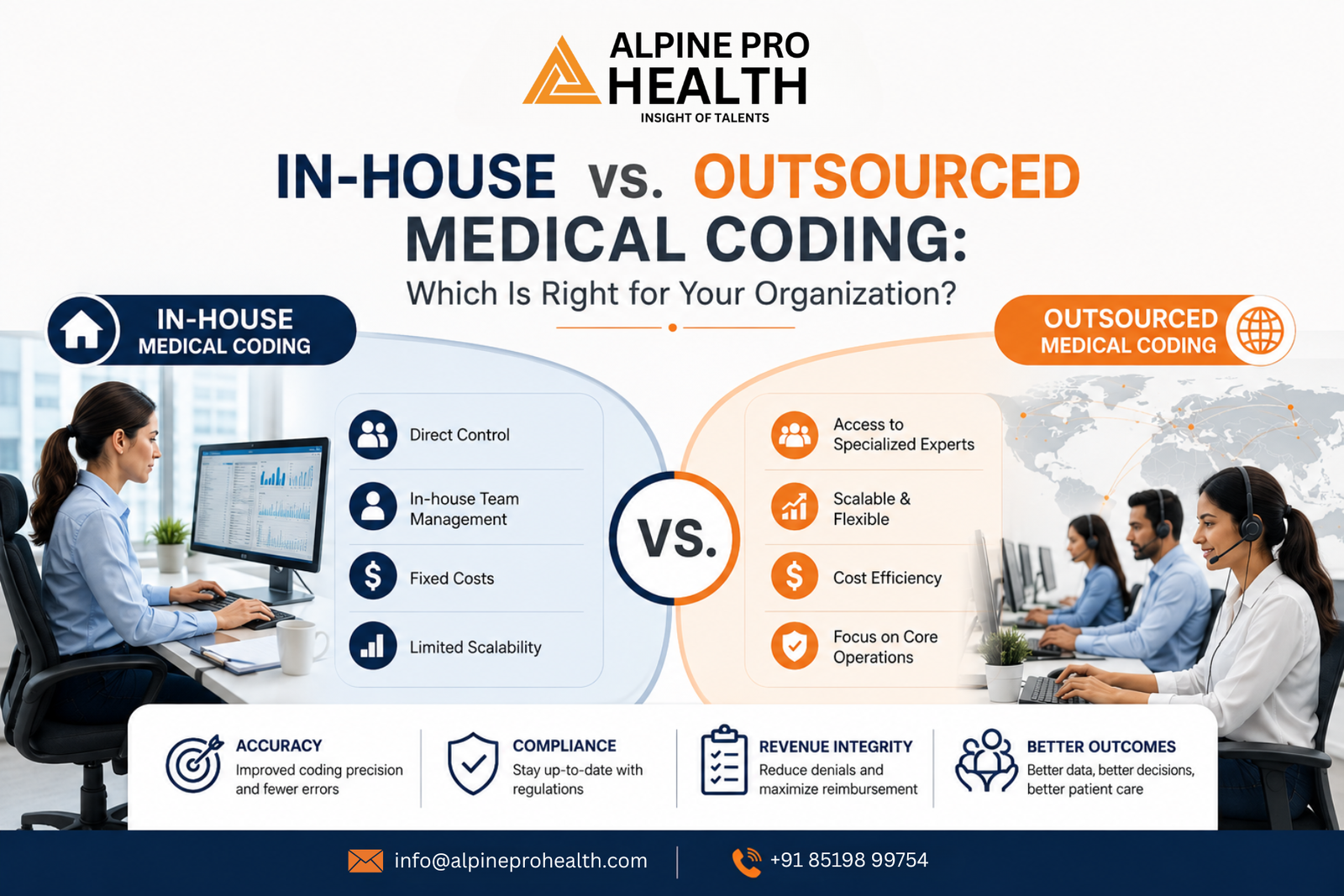
Medical coding is often treated as a back-office function, but its impact reaches much further. Coding influences claim accuracy, reimbursement, compliance, revenue integrity, and the efficiency of the broader revenue cycle.
That makes one question increasingly important for healthcare organizations:
Should medical coding remain in-house, or should it be outsourced to a specialized medical coding partner?
There is no universal answer.
An in-house team can provide direct oversight and close collaboration with internal departments. Outsourcing, on the other hand, can provide access to specialized coding expertise, scalable resources, structured quality processes, and technology without requiring an organization to build everything internally.
The right decision depends on your organization’s coding volume, specialty mix, staffing capacity, quality requirements, technology infrastructure, growth plans, and revenue cycle goals.
Let’s compare both approaches and look at when each model makes the most business sense.
What Is In-House Medical Coding?
In-house medical coding means your organization employs and manages its own coding professionals.
Your internal team is responsible for reviewing clinical documentation and assigning appropriate diagnosis and procedure codes according to applicable coding guidelines and payer requirements.
Depending on the organization, an in-house coding department may handle:
- Inpatient coding
- Outpatient coding
- E/M coding
- Emergency department coding
- Surgery coding
- Specialty coding
- HCC and risk adjustment coding
- DRG coding
- Coding audits
- Documentation-related reviews
The organization controls recruitment, training, quality monitoring, productivity expectations, technology, scheduling, and day-to-day management.
For organizations with established coding departments and predictable workloads, this model can work well.
But it also comes with ongoing operational responsibilities.
What Is Outsourced Medical Coding?
Outsourced medical coding means working with an external medical coding company that provides coding professionals and related services.
Instead of building and managing the entire coding operation internally, the healthcare organization works with a specialized team that handles agreed-upon coding functions.
Outsourced medical coding may include:
- Inpatient coding
- Outpatient coding
- E/M coding
- ED coding
- IP-DRG coding
- HCC coding
- Risk adjustment coding
- Specialty coding
- Coding audits
- CDI support
The exact model can vary. An organization might outsource its entire coding operation or outsource only specific specialties, workloads, or high-volume areas.
This flexibility is one reason outsourcing can be attractive to organizations dealing with changing volumes or specialized coding requirements.
In-House vs. Outsourced Medical Coding: At a Glance
| Factor | In-House Coding | Outsourced Coding |
|---|---|---|
| Staffing | Internal recruitment | External coding team |
| Management | Managed internally | Managed through service partner |
| Scalability | Requires additional hiring | Can scale with demand |
| Specialty expertise | Depends on internal staff | Access to broader expertise |
| Training | Organization manages training | Partner manages coder education |
| Quality assurance | Internal QA resources | Partner-led QA + agreed metrics |
| Technology | Organization invests directly | Partner may provide technology |
| Coverage | Dependent on staff availability | Can provide broader coverage |
| Operational control | High | Shared through governance |
| Cost structure | Fixed internal overhead | Service-based model |
| Best fit | Stable, mature coding operations | Variable volume or specialized needs |
The key point is that outsourcing isn’t automatically better, and in-house coding isn’t automatically more cost-effective.
The right model depends on the organization’s specific circumstances.
The Advantages of In-House Medical Coding
1. Direct Operational Control
With an internal coding team, leadership has direct control over staffing, workflows, priorities, productivity expectations, and escalation processes.
This can be particularly valuable when coding teams work closely with internal HIM, CDI, compliance, and revenue cycle departments.
2. Close Collaboration
Internal coders can communicate directly with physicians, CDI specialists, auditors, and other departments.
For organizations with highly integrated workflows, this proximity can make collaboration easier.
3. Established Organizational Knowledge
Experienced internal coders often become familiar with an organization’s documentation patterns, EHR workflows, specialty mix, payer environment, and internal policies.
That institutional knowledge can be valuable.
4. Direct Management of Priorities
If coding priorities change, internal management can immediately redirect resources.
For example, leadership might prioritize:
- High-value accounts
- Specific specialties
- Coding backlogs
- Audit preparation
- New service lines
However, these benefits must be balanced against the cost and complexity of maintaining the entire operation.
The Challenges of In-House Medical Coding
Staffing Can Become a Constant Challenge
Recruiting qualified coders is only the beginning.
Organizations also need to manage:
- Employee retention
- Absences
- Turnover
- Training
- Productivity
- Continuing education
- Quality audits
- Specialty coverage
When experienced coders leave, replacing them can take time.
That can create backlogs and affect coding turnaround.
Workload Fluctuations Can Be Difficult to Manage
Healthcare volumes aren’t always predictable.
A sudden increase in patient encounters can quickly increase coding workloads.
With an internal model, additional volume may require:
More employees → recruitment → onboarding → training → productivity ramp-up
That isn’t always fast enough for changing operational demands.
Technology Requires Investment
Organizations managing coding internally also need to evaluate technology that supports:
- Coding workflows
- Quality assurance
- Auditing
- Documentation review
- Productivity monitoring
- Reporting
- Security
Technology can improve internal operations, but it requires investment and ongoing management.
The Advantages of Outsourced Medical Coding
1. Access to Specialized Expertise
A specialized medical coding company can provide access to professionals experienced in different coding areas and specialties.
This can be especially useful for organizations handling complex coding requirements across multiple service lines.
Instead of maintaining every specialty internally, an organization can access external expertise when it needs it.
2. Greater Scalability
One of the strongest arguments for outsourcing is flexibility.
If coding volume increases, organizations can work with their partner to increase capacity rather than immediately recruiting and training additional employees.
This can be particularly useful during:
- Seasonal volume increases
- New provider onboarding
- Acquisitions
- Expansion into new specialties
- Coding backlogs
- Staffing shortages
Current industry discussions around coding outsourcing continue to emphasize scalability, specialized expertise, quality, and operational continuity as important reasons organizations evaluate external partners.
3. Reduced Internal Administrative Burden
Outsourcing can shift some operational responsibilities to the coding partner.
Instead of spending internal resources on recruiting, scheduling, training, and managing every coding position, leadership can focus more on broader revenue cycle and organizational priorities.
4. Access to Structured Quality Processes
Established coding partners typically operate with defined quality assurance processes, productivity monitoring, coder education, and performance reporting.
However, healthcare organizations should verify these processes during vendor evaluation rather than assuming every provider follows the same standards.
The Challenges of Outsourced Medical Coding
Outsourcing also has potential drawbacks.
Less Direct Day-to-Day Control
Your organization is no longer managing every coding activity internally.
That’s why vendor governance becomes important.
Before signing an agreement, establish:
- Quality expectations
- Turnaround requirements
- Productivity metrics
- Escalation procedures
- Reporting requirements
- Security requirements
- Audit processes
- Communication protocols
Vendor Selection Matters
Not every medical coding company offers the same level of expertise.
Choosing primarily on price can create problems later.
A low-cost provider that produces inconsistent quality may create additional rework, denials, compliance concerns, or management burden.
The objective should be value, not simply the lowest price.
Which Option Is More Cost-Effective?
This is where many organizations make the wrong comparison.
They compare:
Internal coder salary
against
Outsourcing fee
But that’s not a complete comparison.
The true cost of an in-house coding operation may also include:
- Benefits
- Recruitment
- Employee turnover
- Training
- Management
- Software
- Hardware
- Quality assurance
- Continuing education
- Productivity management
- Coverage during absences
- Additional staffing during volume increases
Outsourcing also has costs, of course.
The better question is:
Which model provides the best total value for our coding volume, quality requirements, operational needs, and revenue goals?
A simple cost comparison can therefore be misleading.
When Does In-House Medical Coding Make Sense?
In-house coding may be a good fit when your organization has:
Stable Coding Volume
If coding volume is predictable and consistent, maintaining an internal team may be practical.
Strong Internal Leadership
Organizations with experienced HIM and coding leadership may already have the infrastructure needed to manage a high-performing coding operation.
Specialized Internal Expertise
If your organization has highly specialized coding requirements and an experienced internal team, keeping those capabilities internally may provide value.
Strong Recruitment and Retention
An internal model becomes easier to maintain when qualified coders are readily available and turnover is manageable.
When Does Outsourced Medical Coding Make Sense?
Outsourcing may be worth considering when your organization is experiencing:
Coding Staff Shortages
If recruiting qualified coders has become difficult, outsourcing can provide access to an established team.
If encounter volume is increasing faster than internal capacity, an external partner can provide additional resources.
Growing Coding Backlogs
Specialty Coding Challenges
Organizations that need expertise across multiple specialties may benefit from a broader external coding team.
Variable Workloads
Outsourcing provides greater flexibility when coding volume changes significantly.
Revenue Integrity Concerns
If coding errors, documentation gaps, denials, or missed reimbursement opportunities are affecting revenue cycle performance, an independent coding partner may provide additional expertise and quality oversight.
What About a Hybrid Medical Coding Model?
There is another option that organizations sometimes overlook:
The hybrid model.
You don’t necessarily have to choose between 100% in-house and 100% outsourced coding.
A healthcare organization could keep core coding functions internally while outsourcing selected areas.
For example:
Internal team:
- Core inpatient coding
- Internal audits
- Physician collaboration
External partner:
- Outpatient coding
- ED coding
- HCC reviews
- Coding backlog
- Specialty coding
- Overflow volume
This approach can provide internal control while adding external capacity where it creates the most value.
For some organizations, this may be the most practical starting point.
7 Questions to Ask Before Outsourcing Medical Coding
If you’re considering outsourcing, don’t evaluate vendors based only on price.
Ask:
1. Do you have experience with our specialties?
Specialty expertise matters because coding requirements can vary significantly by service line.
2. How do you measure coding accuracy?
Ask about quality audits, sampling methodology, reporting, and corrective action.
3. How do you manage coder education?
Coding guidelines and payer requirements change. Your partner should have a process for keeping coders current.
4. How quickly can you scale?
Ask how the provider handles volume increases, new specialties, and unexpected backlogs.
5. What technology supports your coding workflow?
Understand whether the provider uses automation, AI-assisted review, analytics, auditing tools, or other technologies.
6. How will you communicate performance?
You should have visibility into metrics such as:
- Accuracy
- Productivity
- Turnaround time
- Backlog
- Quality trends
7. Can you demonstrate measurable results?
Ask for relevant case studies, references, or examples of outcomes—while ensuring any claims are appropriately documented.
How AI Is Changing the In-House vs. Outsourcing Decision?
Technology is changing how healthcare organizations approach coding.
AI-assisted and automation-enabled workflows can help identify potential coding issues, prioritize charts, surface documentation gaps, and support quality reviews.
But technology doesn’t eliminate the need for qualified coding professionals.
The more useful question is:
Which model combines technology and human expertise most effectively for our organization?
A strong outsourced medical coding partner may combine certified coders with intelligent technology to improve productivity and quality.
Likewise, healthcare organizations with mature internal teams can invest in similar technology.
The competitive advantage isn’t simply AI.
It’s the combination of:
Technology + Coding Expertise + Quality Assurance + Clinical Documentation + Governance
How to Decide Which Model Is Right for Your Organization?
Use this simple framework.
Choose primarily in-house if:
- Your coding volume is stable
- You have strong internal coding leadership
- Staffing is reliable
- Specialty expertise is already available
- Your quality metrics are consistently strong
- Your organization has the resources to maintain technology and training
Consider outsourcing if:
- You have persistent staffing challenges
- Coding backlogs are growing
- Volume fluctuates
- You need specialty expertise
- You want additional scalability
- Internal resources are stretched
- You want to strengthen coding quality or revenue integrity
Consider hybrid if:
- You want to retain internal control
- Certain specialties require external expertise
- You need overflow capacity
- You want to test outsourcing before making a broader transition
Why the Right Medical Coding Partner Matters?
If you decide to outsource, the provider you choose can make a significant difference.
A good medical coding partner should function as an extension of your healthcare organization—not simply as a vendor processing charts.
Look for a partner that understands:
Coding → Documentation → Claims → Denials → Revenue Integrity
At Alpine Pro Health, our approach combines experienced medical coding professionals with technology-enabled workflows to support healthcare organizations across multiple coding and revenue cycle functions.
Our services span areas including inpatient coding, outpatient coding, E/M coding, ED coding, IP-DRG coding, HCC coding, risk adjustment, and coding audits.
For organizations considering outsourcing, the objective should be more than reducing internal workload. The right partner should help create a more accurate, scalable, and sustainable coding operation.
Final Verdict: In-House or Outsourced Medical Coding?
There isn’t a universal winner.
In-house medical coding can provide strong control, collaboration, and institutional knowledge when an organization has the people, infrastructure, and volume to support it effectively.
Outsourced medical coding can provide scalability, specialized expertise, and operational flexibility when internal resources are stretched or changing business needs make staffing difficult.
And for many organizations, a hybrid model may provide the best balance.
The decision should ultimately come down to four questions:
Can we maintain the required quality?
Can we scale when volume changes?
Can we manage the operational cost effectively?
Can our current model support our revenue integrity goals?
If the answer to several of these questions is no, it may be time to evaluate outsourced medical coding.
Conclusion
The question isn’t simply whether in-house or outsourced medical coding is better.
The better question is:
Which model gives your organization the accuracy, expertise, scalability, and financial performance it needs?
For some healthcare organizations, that answer will be an internal team. For others, it will be outsourcing. And for many, a combination of both may be the most effective approach.
As coding complexity and revenue cycle demands continue to evolve, choosing the right operating model can become an important part of protecting revenue and maintaining coding quality.
Looking to evaluate your current medical coding workflow?
Connect with Alpine Pro Health to explore a scalable medical coding solution built around your organization’s needs.